
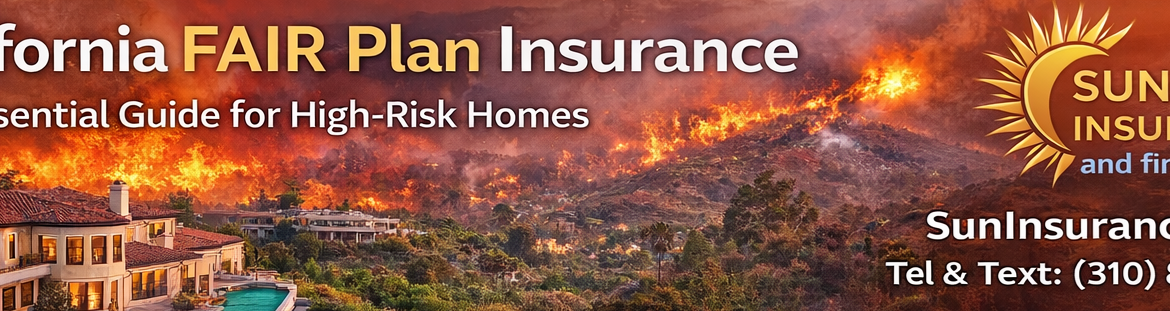
Article 1 of a 3-Part Series on Protecting High-Risk Homes in California 🔥🏡
California homeowners are facing a new reality.
Wildfires are no longer rare seasonal events that happen far away in the mountains. Over the past decade, fires have spread across suburban communities, coastal hillsides, and even luxury neighborhoods that once believed they were immune to wildfire risk.
In places like Malibu, Beverly Hills, Santa Monica Mountains, Calabasas, Pasadena, Napa Valley, and many hillside communities across California, thousands of homeowners have received the same shocking notice from their insurance company:
“Your homeowners’ insurance policy will not be renewed.”
For many families, this moment feels like the floor has dropped out from under them. Mortgage lenders require insurance. Without it, the home loan may go into default. Selling the house becomes difficult. And finding a new insurer becomes nearly impossible.
This is exactly where the California FAIR Plan comes into play.
The FAIR Plan is often misunderstood. Some people think it is a government subsidy. Others believe it provides full homeowners coverage. In reality, it is something very different.
The California FAIR Plan is a last-resort insurance solution for homes that traditional insurers refuse to cover due to high wildfire risk.
In this article—the first in a three-part series about insurance for high-risk homes in California—we will explain:
• What the California FAIR Plan is
• Why are so many homeowners being forced into it
• What it covers and what it does not cover
• Real scenarios where homeowners needed FAIR Plan insurance
• Why relying on the FAIR Plan alone can be financially dangerous
• How homeowners can properly structure coverage to protect their property
If you own a home in a wildfire-exposed area—or if your insurance company has recently canceled your policy—this guide may be one of the most important financial reads of the year.
Why California Homeowners Are Losing Insurance 🔥
To understand the importance of the California FAIR Plan, we first need to understand what has happened in the insurance market.
Over the past several years, wildfire losses have reached historic levels.
Major fires such as:
• Camp Fire
• Woolsey Fire
• Dixie Fire
• Thomas Fire
• Tubbs Fire
caused tens of billions of dollars in insurance losses.
Insurance companies operate based on risk calculations. When losses repeatedly exceed expectations, companies must adjust. Many carriers responded by:
• Reducing exposure in wildfire zones
• Refusing to insure homes in certain ZIP codes
• Increasing underwriting requirements
• Canceling or non-renewing policies
Even homeowners who never filed a claim suddenly found themselves without insurance.
Scenario: Malibu Homeowner Loses Coverage
Imagine a homeowner in Malibu who purchased a beautiful hillside property for $2.8 million.
The home had insurance for years. Then, after several wildfires in nearby areas, the insurance company sent a non-renewal notice.
Suddenly, the homeowner must find insurance within 30 days.
Most insurance companies decline coverage because the home sits near brushland and wildfire-prone areas.
At that moment, the homeowner discovers the California FAIR Plan.
What Is the California FAIR Plan?
The California FAIR Plan (Fair Access to Insurance Requirements) was created in 1968 after riots made it difficult for homeowners in certain areas to obtain insurance.
Today, the FAIR Plan primarily serves homeowners in high wildfire-risk areas.
It is not a government insurance company. Instead, it is a pool funded by private insurance companies that operate in California.
All insurers writing property insurance in California are required to participate.
The purpose is simple:
👉 Ensure that homeowners who cannot obtain insurance in the regular market still have access to basic fire coverage.
Think of it as a safety net for properties considered too risky for standard insurance companies.
What the California FAIR Plan Covers

The FAIR Plan primarily provides fire insurance.
Coverage generally includes:
🔥 Fire damage
🔥 Lightning damage
🔥 Smoke damage
🔥 Internal explosions
In other words, the policy is designed to protect homeowners from the most catastrophic wildfire-related events.
But here is the critical detail many homeowners do not realize:
⚠️ The FAIR Plan is not a full homeowners insurance policy.
This is one of the biggest misunderstandings among property owners.
What the FAIR Plan Does NOT Cover 🚫
The FAIR Plan typically does not include several major protections found in traditional homeowners’ policies.
For example, it usually does not include:
• Personal liability protection
• Water damage coverage
• Theft coverage
• Personal property coverage
• Loss of use protection
• Medical payments liability
Without these protections, a homeowner may be financially exposed.
Scenario: Liability Risk
Imagine a homeowner in the Beverly Hills Post Office area with only a FAIR Plan policy.
A guest slips and falls near the swimming pool and suffers a serious injury.
Because the FAIR Plan does not provide liability coverage, the homeowner could face hundreds of thousands of dollars in legal claims without protection.
This is why insurance professionals often recommend pairing the FAIR Plan with a Difference in Conditions (DIC) policy, which we will discuss later.
Why High-Value Homes Often End Up on the FAIR Plan
Many luxury homes in California are located in scenic areas such as:
• Malibu hillsides
• Pacific Palisades canyon areas
• Santa Monica Mountains
• Napa and Sonoma wine country
• Lake Tahoe forest communities
These beautiful landscapes often feature dense vegetation, steep slopes, and limited access roads, making them prone to fire.
From an insurance perspective, these factors increase wildfire risk.
Even homes worth $3 million, $5 million, or $10 million may struggle to find private insurance.
Scenario: Beverly Hills Hillside Property
A homeowner buys a $6.5 million home overlooking Beverly Hills.
The home sits near natural vegetation on a hillside.
Several insurance companies decline the risk because:
• Fire department access is limited
• The property borders wildfire-exposed terrain
• Nearby fires occurred in recent years
The only available option becomes the California FAIR Plan.
Why the FAIR Plan Alone Is Dangerous ⚠️
Although the FAIR Plan provides essential fire coverage, relying on it alone can be risky.
Homeowners often assume they are fully protected.
But many exposures remain uncovered.
Imagine these real-world events:
💧 A pipe bursts and floods the kitchen
💎 Jewelry is stolen during a break-in
⚖️ A contractor sues after an injury on the property
🌧 A rainstorm damages the roof
The FAIR Plan generally does not cover these losses.
Without additional insurance, the homeowner may pay out of pocket.
The Importance of a Difference in Conditions (DIC) Policy
To solve this problem, many insurance professionals recommend pairing the FAIR Plan with a Difference in Conditions (DIC) policy.
A DIC policy fills the coverage gaps.
It may provide:
• Liability coverage
• Theft protection
• Water damage coverage
• Personal property coverage
• Loss of use protection
Together, the FAIR Plan + DIC policy creates a structure similar to a full homeowners insurance policy.
Real Scenario: Malibu Wildfire Recovery 🔥

During the Woolsey Fire, many homes in Malibu were damaged or destroyed.
Some homeowners had standard insurance.
Others had the FAIR Plan.
Those with properly structured coverage recovered much faster because the policies helped cover rebuilding costs.
Homeowners without sufficient coverage often faced long financial recovery periods.
Wildfires do not only destroy property—they disrupt lives, businesses, and communities.
Insurance is the financial bridge that allows homeowners to rebuild.
Why FAIR Plan Demand Is Increasing
Over the past few years, FAIR Plan enrollment has grown dramatically.
More than hundreds of thousands of California homeowners now rely on it.
The reasons include:
🔥 Increased wildfire frequency
🔥 Rising property reconstruction costs
🔥 Insurance carrier risk reductions
🔥 Climate-related risk modeling
For many homeowners in wildfire-exposed areas, the FAIR Plan has become the only available option.
How Much Does FAIR Plan Insurance Cost?
Costs vary depending on several factors:
• Property value
• Location
• Fire risk score
• Construction type
• Roof materials
• Fire mitigation features
Premiums for high-risk homes can range from a few thousand to tens of thousands of dollars per year.
Homes in extremely high-risk wildfire zones may see premiums significantly higher than traditional homeowners’ insurance.
How Homeowners Can Reduce Risk
Insurance companies often evaluate fire mitigation measures.
Homeowners may improve insurability by:
🌿 Clearing brush and vegetation near the home
🔥 Installing fire-resistant roofing materials
🚒 Improving access for emergency vehicles
🧱 Using fire-resistant building materials
💧 Installing sprinkler systems
These steps can reduce wildfire risk and may improve insurance options.
Why Professional Guidance Matters
Navigating FAIR Plan insurance is complex.
Every home is different.
Coverage limits, property valuation, and additional policies must be carefully structured.
A poorly structured insurance plan can leave homeowners exposed to major financial losses.
Insurance professionals who understand the California wildfire insurance market can help design a complete protection strategy.
Article Series: Protecting High-Risk Homes in California
This article is Part 1 of a 3-part series designed to help homeowners understand insurance options for wildfire-exposed properties.
Article 1
California FAIR Plan Insurance: The Essential Guide for High-Risk Homes
Article 2
Difference in Conditions (DIC) Insurance: The Missing Protection FAIR Plan Homeowners Need
Article 3
Wildfire Insurance Strategies for Luxury Homes in Malibu, Beverly Hills, and High-Risk Areas
Together, these articles will explain how homeowners can build a complete protection plan for high-risk properties in California.
Final Thoughts
Owning property in California offers incredible lifestyle benefits—beautiful weather, stunning landscapes, and vibrant communities.
But with those benefits come real risks.
Wildfires are now a permanent part of the California landscape.
For homeowners who cannot obtain traditional insurance, the California FAIR Plan provides an essential safety net.
However, it should rarely be the only layer of protection.
A well-structured insurance strategy may include:
• FAIR Plan coverage
• Difference in Conditions policy
• Liability protection
• Additional catastrophe coverage
When properly designed, this structure can protect homeowners from devastating financial losses.
Get a Quick California FAIR Plan Insurance Quote
If your homeowners’ insurance was canceled, non-renewed, or if your property is located in a wildfire-risk area, professional guidance can help you secure proper coverage.
To get a quick quote or discuss your options, contact:
🌐 SunInsurance.us
📞 Telephone or Text: (310) 860-5000
Protect your home. Protect your investment. Protect your peace of mind. 🏡🔥
Protect your business today — before a lawsuit becomes tomorrow’s financial crisis.
#CaliforniaFAIRPlan
#FAIRPlanInsurance
#CaliforniaFireInsurance
#WildfireInsurance
#HighRiskHomeInsurance
#CaliforniaHomeInsurance
#HomeInsuranceCalifornia
#FireInsuranceCalifornia
#CaliforniaWildfireRisk
#DifferenceInConditions
#DICInsurance
#HomeInsuranceGapCoverage
#MalibuHomeInsurance
#BeverlyHillsHomeInsurance
#SantaMonicaHomeInsurance
#LosAngelesHomeInsurance
#LuxuryHomeInsurance
#HighValueHomeInsurance
#WildfireZoneInsurance
#HomeownersInsurance
#PropertyInsurance
#InsuranceForHomeowners
#SunInsurance
#SunInsuranceFinancial
#SunInsuranceUS