
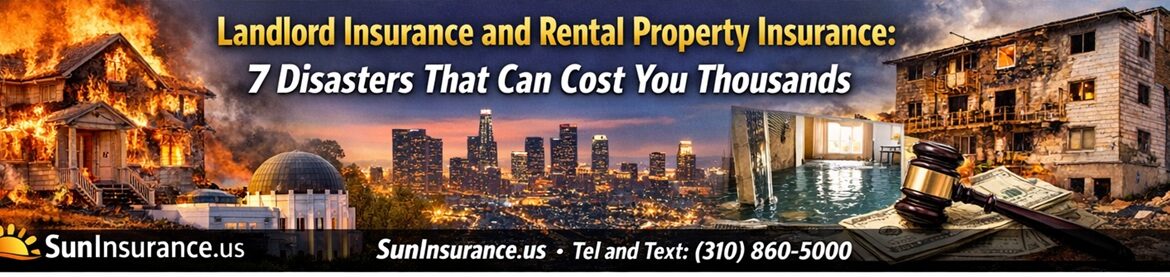
This is Article 2 of a 3-Part Series on Landlord Insurance in California.
Owning rental property in California can be one of the most powerful ways to build long-term wealth, especially in high-demand markets like Los Angeles, Beverly Hills, Santa Monica, Malibu, and Irvine. But here’s the part most landlords don’t see coming until it’s too late: one uncovered loss can erase years of income in a single incident. That’s why Landlord Insurance and Rental Property Insurance are not optional—they are your financial shield. This is not theory or textbook advice. These are real-world scenarios happening across California every day, and if your coverage is not structured correctly, you are exposed.
🔥 Disaster #1: Tenant Causes an $85,000 Fire in a Santa Monica Duplex
A landlord in Santa Monica rented a duplex to a tenant who quietly operated a small electronics repair business from the unit. One night, faulty wiring from equipment triggered a fire that spread quickly through the structure. The total damage reached $65,000 for structural repairs and another $20,000 in lost rental income while the unit sat vacant. The landlord assumed his homeowners’ policy would cover the loss, but the claim was denied under a business-exclusion clause. This single oversight resulted in an $85,000 out-of-pocket loss. In short, standard homeowners policies aren’t designed for rental exposure. Proper Landlord Insurance and Rental Property Insurance would have included commercial property protection and loss-of-rental-income coverage, ensuring both physical damage and income disruption were covered.
⚖️ Disaster #2: Slip-and-Fall Lawsuit Costs $240,000 in Beverly Hills
In a Beverly Hills fourplex, a tenant’s guest slipped on a dimly lit staircase and suffered a serious injury. What seemed like a minor maintenance issue turned into a full legal case. Medical expenses reached $90,000, legal defense costs another $60,000, and the final settlement came in at $90,000. The landlord carried only $100,000 in liability coverage, leaving a $140,000 gap that had to be paid out of pocket. In California, liability claims escalate quickly, especially in high-income areas. Landlord Insurance and Rental Property Insurance should always include at least $1 million in liability coverage. In many cases, an umbrella policy is essential to protect assets beyond the property itself.
🌊 Disaster #3: Water Damage Destroys Three Units in a Los Angeles Apartment
A six-unit apartment building in Los Angeles experienced a major pipe burst that flooded three units overnight. Repair costs totaled $55,000, tenant relocation added another $12,000, and lost rental income reached $18,000 while units were under repair. The landlord did have insurance, but without loss-of-rent coverage, only the physical repairs were reimbursed. The remaining financial hit came directly from the landlord’s pocket. This is a classic example of incomplete coverage. Landlord Insurance and Rental Property Insurance must include not just property protection but also income replacement and ordinance and law coverage, especially in California, where building code upgrades can significantly increase repair costs.
⚠️ Disaster #4: Wrongful Eviction Lawsuit Costs $95,000 in Irvine
A landlord in Irvine attempted to evict a tenant during a lease dispute without fully complying with updated California regulations. The tenant filed a wrongful eviction lawsuit, resulting in $35,000 in legal defense costs and a $60,000 settlement. The landlord had no EPLI Insurance or enhanced liability coverage to handle tenant-related legal claims. California tenant laws are complex and heavily enforced, and even experienced landlords can make costly mistakes. Landlord Insurance and Rental Property Insurance should be structured to include legal expense protection and, where appropriate, EPLI Insurance to cover claims tied to tenant disputes.
🔌 Disaster #5: Electrical Fire Causes $310,000 Loss in Malibu Rental
A high-value rental property in Malibu suffered an electrical fire due to outdated wiring. The total damage reached $250,000 for the structure and $60,000 in liability-related claims. However, the property had been undervalued on the policy, leaving the landlord underinsured by approximately 40 percent. The insurance payout covered only $186,000, forcing the landlord to absorb the remaining loss. Underinsurance is one of the most common and expensive mistakes landlords make. Proper Landlord Insurance and Rental Property Insurance must be reviewed annually to ensure replacement cost accuracy and include inflation guard protection, especially in California, where construction costs continue to rise.

🚨 Disaster #6: Squatter Occupies Property for Five Months in Los Angeles
A vacant rental property in Los Angeles was taken over by squatters, leading to a prolonged legal eviction process. The landlord faced $18,000 in legal costs, $25,000 in lost rent, and $22,000 in property damage. Without a vacancy endorsement, the insurance policy provided limited protection. Vacant properties are significantly higher risk, particularly in California’s urban markets. Landlord Insurance and Rental Property Insurance should include vacancy clauses or specialized coverage when properties are unoccupied, along with proactive tenant placement strategies to minimize exposure.
🦠 Disaster #7: Mold Claim Leads to $120,000 Loss in Beverly Hills Condo
A tenant in a Beverly Hills condo claimed mold exposure due to a minor leak that went unaddressed for weeks. The situation escalated into a health-related claim involving remediation, legal costs, and settlement, totaling approximately $120,000. The landlord’s policy had limited mold coverage, leaving a substantial portion unpaid. Mold claims are increasingly common in California due to moisture issues and strict habitability standards. Landlord Insurance and Rental Property Insurance should include mold endorsements and maintenance protocols to reduce the likelihood of such claims.
🧠 What Smart California Landlords Do Differently
Experienced landlords in California understand that success is not just about collecting rent—it’s about protecting income, assets, and long-term financial stability. They structure their Landlord Insurance and Rental Property Insurance to include commercial property coverage, strong liability limits, loss-of-rental-income protection, ordinance and law coverage, and specialized endorsements, such as vacancy coverage and mold protection. They also review their policies annually to adjust for rising property values and evolving risks.
🔗 Related Coverages Every Landlord Should Consider
In addition to core Landlord Insurance and Rental Property Insurance, California property owners should evaluate related protections such as Cyber Liability Insurance for tenant data risks, EPLI Insurance for legal disputes, Workers Compensation Insurance if employees or maintenance staff are involved, Medical Office Insurance for mixed-use properties, Commercial Property Insurance for broader asset protection, and California FAIR Plan policies for properties in high-risk fire zones. These coverages work together to create a comprehensive risk management strategy.

❓ FAQ: Landlord Insurance and Rental Property Insurance in California
What is the difference between landlord insurance and homeowners insurance in California? Landlord Insurance and Rental Property Insurance are designed specifically for income-producing properties and include liability, property, and rental income protection, whereas homeowners’ insurance is intended for owner-occupied residences.
Do I need landlord insurance for a single rental property? Yes, even a single rental property carries significant liability and income risks, especially in California’s legal environment.
Does landlord insurance cover loss of rent? Only if the policy includes loss-of-rental-income coverage, which is a critical component.
Is landlord insurance required in California? It is not legally required, but lenders’ risk exposure makes it essential.
🚀 Final Thought
Every one of these disasters is preventable—or at least financially manageable—with the right Landlord Insurance and Rental Property Insurance structure. The difference between a minor setback and a financial crisis often comes down to how your policy is built. In California, where property values, legal exposure, and repair costs are among the highest in the nation, cutting corners on insurance is one of the most expensive decisions a landlord can make.
👉 To get a quick quote and properly protect your rental property, contact SunInsurance.us
Tel or Text: (310) 860-5000
#LandlordInsurance #RentalPropertyInsurance #CaliforniaLandlords #RealEstateInvesting #LosAngelesRealEstate #BeverlyHillsRealEstate #SantaMonicaRentals #MalibuHomes #IrvineRealEstate #PropertyInsurance
Protect your personal and business today — before a lawsuit becomes tomorrow’s financial crisis.